

Table of Contents
Early Learning Activities shape how children think, communicate, and solve problems during their most critical growth years. According to UNICEF data updated in 2025, 90% of brain development happens before age five, making early experiences decisive for lifelong learning. When children engage in purposeful play, they build language, motor, and social skills simultaneously. This is why play-based learning remains a global priority in childhood education systems.
In the United States, the National Institute for Early Education Research reported in 2025 that children exposed to structured early activities show a 31% improvement in early literacy outcomes by kindergarten. These results are not accidental. They stem from consistent, age-appropriate learning opportunities embedded into daily routines.
Early Learning Activities do not require expensive tools or rigid schedules. What matters is intentional interaction, repetition, and exploration. From storytelling to sensory play, each activity strengthens neural connections and emotional confidence. When families and educators work together, children gain measurable advantages in attention, memory, and problem-solving.
Why Early Learning Activities Matter for Development
Brain Growth and Cognitive Skills
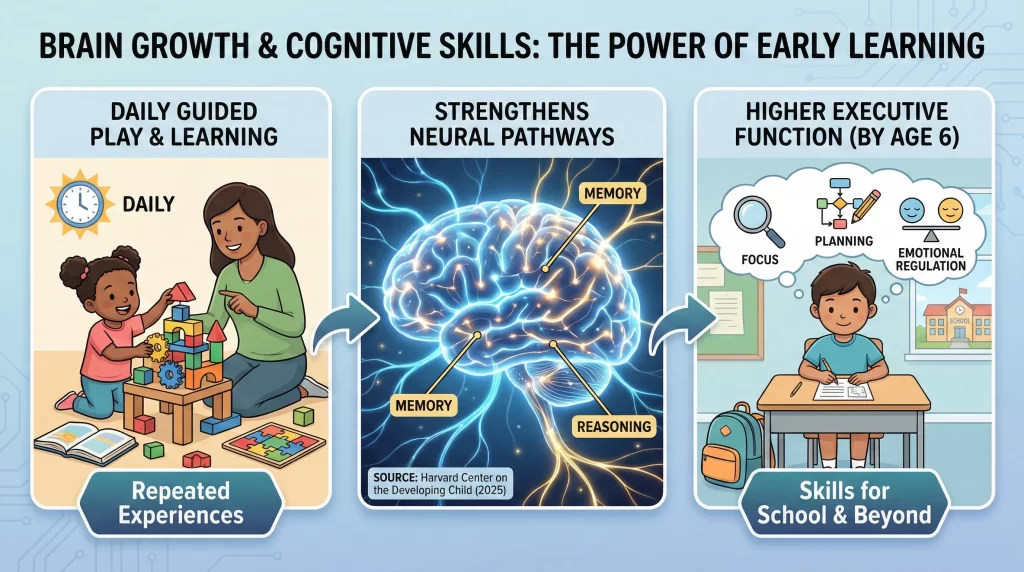
Early Learning Activities directly support brain architecture during peak growth years. Harvard’s Center on the Developing Child confirmed in 2025 that repeated learning experiences strengthen neural pathways responsible for memory and reasoning. Children who engage daily in guided play show higher executive function scores by age six. These skills influence focus, planning, and emotional regulation later in school.
When activities combine movement and thinking, the brain processes information faster. This dual engagement improves retention and understanding. The takeaway is clear: early learning builds cognitive strength that lasts.
Social and Emotional Development
Social growth accelerates when children participate in shared activities. UNICEF reports from 2025 show that cooperative play improves empathy and communication skills by 28% among children aged 3 to 6. Activities that involve turn-taking and role-play teach patience and emotional awareness.
Early Learning Activities also reduce anxiety during school transitions. Children feel safer expressing ideas when learning feels playful. The result is stronger emotional resilience and healthier peer relationships.
10 Fun Early Learning Activities That Work
1. Storytelling and Read-Aloud Sessions
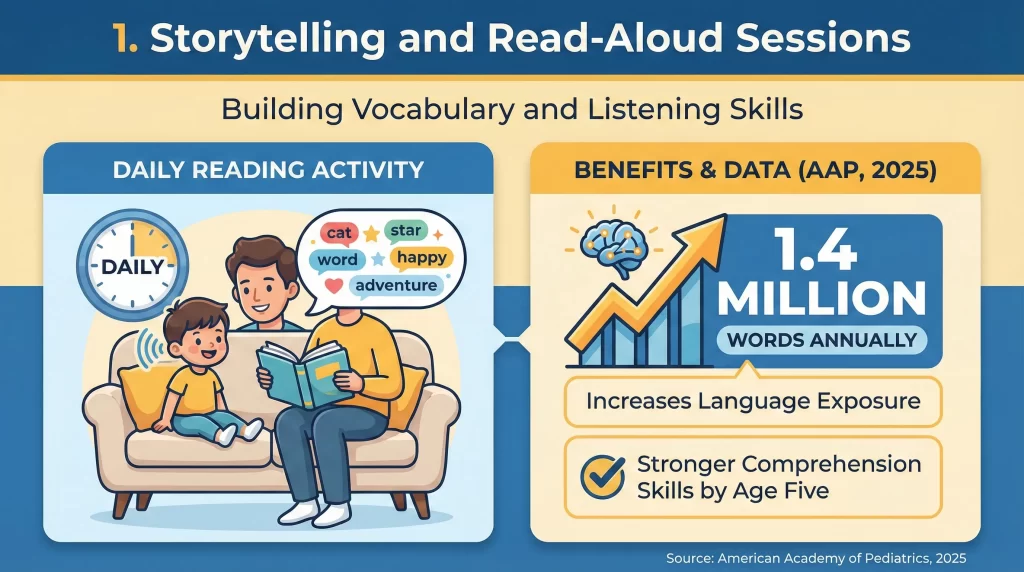
Reading aloud builds vocabulary and listening skills quickly. The American Academy of Pediatrics confirmed in 2025 that daily reading increases language exposure by 1.4 million words annually. Children who hear stories regularly show stronger comprehension skills by age five.
Use expressive voices and open-ended questions. This approach turns reading into an interactive learning experience. The outcome is improved literacy readiness and imagination.
2. Sensory Play with Everyday Materials
Sensory play strengthens fine motor skills and problem-solving. Activities using sand, water, or rice activate multiple brain areas simultaneously. EarlyLearningIdeas.com notes that sensory tasks improve hand-eye coordination within 8 weeks with consistent practice.
These activities help children explore cause and effect safely. The takeaway is better physical control and curiosity-driven learning.
3. Music and Rhythm Games
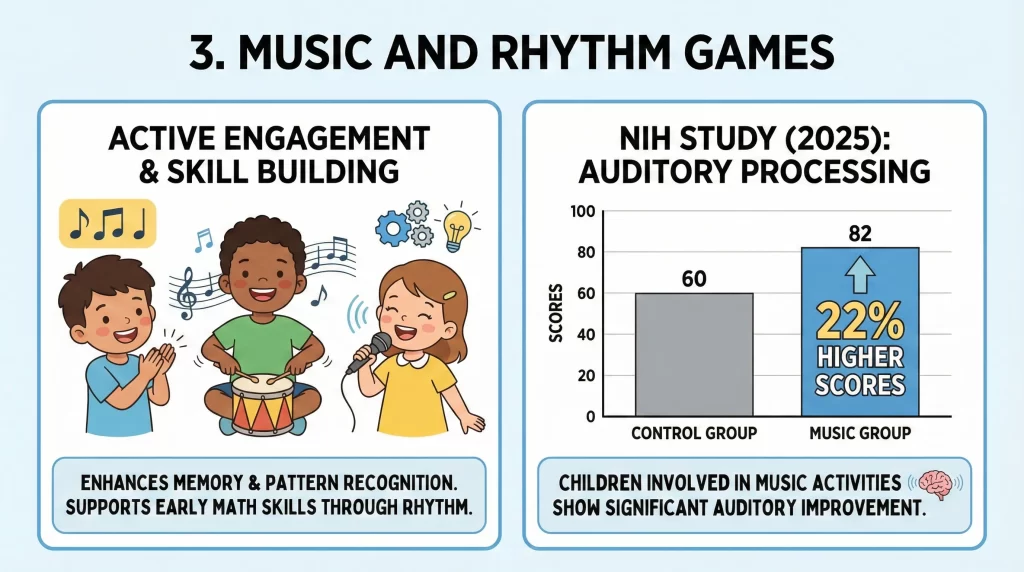
Music enhances memory and pattern recognition. A 2025 NIH study found children involved in music activities scored 22% higher in auditory processing tests. Singing and clapping also support early math skills through rhythm patterns.
Music-based Early Learning Activities improve confidence and self-expression. Children learn structure while having fun. Understand the basics of Montessori education for children and how it supports independence.
4. Pretend Play and Role-Playing
Role-play builds social understanding and language fluency. According to UNICEF’s 2025 play-based learning research, pretend play improves problem-solving skills by 30%. Children practice real-life scenarios safely.
Using costumes or props encourages creativity and cooperation. The result is stronger communication and emotional intelligence.
5. Puzzle and Sorting Games
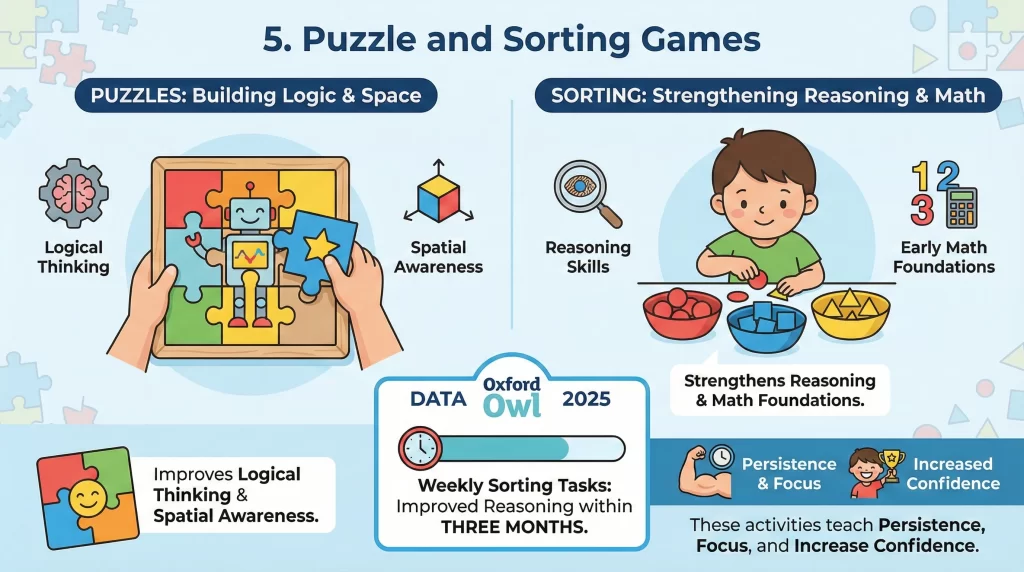
Puzzles improve logical thinking and spatial awareness. Oxford Owl data from 2025 shows that children who complete sorting tasks weekly improve their reasoning skills within three months. Matching shapes and colors also strengthens early math foundations.
These activities teach persistence and focus. The benefits include improved attention span and increased confidence.
6. Art and Creative Expression
Drawing and painting develop fine motor control and emotional expression. ABC Great Beginnings reported in 2025 that creative activities increase hand strength needed for writing by 25%. Art also supports self-esteem through personal expression.
Allow children to choose colors and materials freely. The takeaway is creativity paired with physical development.
7. Outdoor Exploration Activities
Outdoor learning improves physical and mental health. The CDC confirmed in 2025 that children who play outside daily show a 20% reduction in stress indicators. Nature-based activities also improve observation skills.
Simple walks or scavenger hunts encourage curiosity. The result is healthier bodies and sharper awareness. Learn how preschool education benefits help children build early social and academic skills.
8. Number and Counting Games
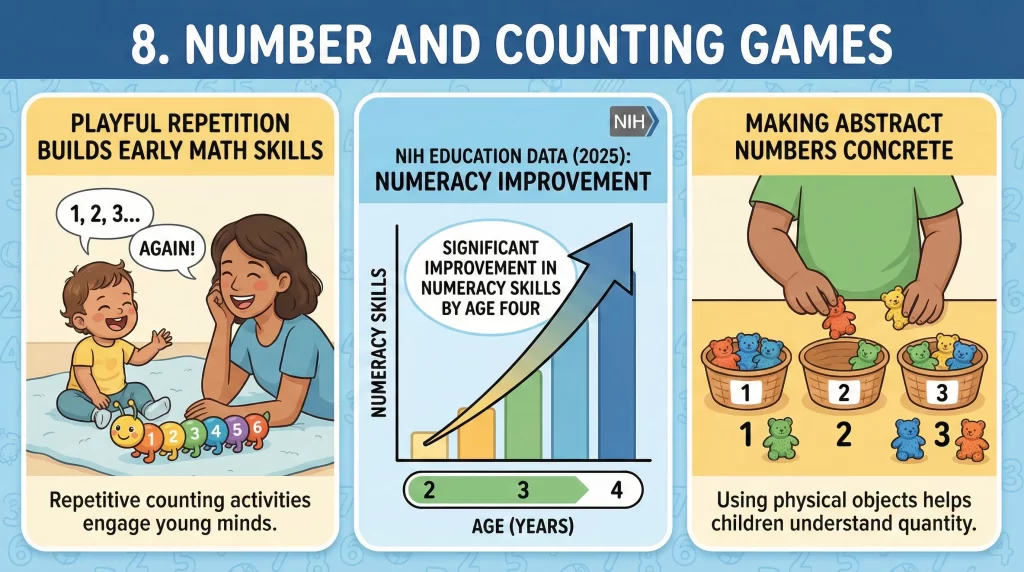
Early math skills develop through playful repetition. NIH education data from 2025 shows counting games improve numeracy skills by age four. Using objects makes abstract numbers concrete.
These Early Learning Activities build early confidence with numbers. The outcome is stronger math readiness.
9. Movement and Action Games
Physical movement supports brain oxygenation and focus. The CDC reported in 2025 that active play improves classroom attention by 18%. Games like hopping or dancing build coordination and balance.
Movement-based learning keeps children engaged longer. The benefit is better physical and mental endurance.
10. Everyday Life Skill Activities
Helping with cooking or cleaning teaches responsibility. UNICEF data from 2025 confirms that life-skill activities improve independence by 35%. Children learn sequencing and practical problem-solving.
Key Benefits at a Glance
- Improves language and literacy development early.
- Strengthens emotional and social skills consistently.
- Builds cognitive flexibility and problem-solving ability.
- Encourages independence and confidence through play.
Early Learning Activities by Development Area
| Activity Type | Skill Developed | Measured Benefit |
|---|---|---|
| Storytelling | Language | 1.4M words exposure yearly |
| Sensory Play | Motor Skills | Improved coordination in 8 weeks |
| Music Games | Memory | 22% higher auditory processing |
| Pretend Play | Social Skills | 30% better problem-solving |
| Number Games | Math Readiness | Higher numeracy by age four |
Bottom Line
Early Learning Activities are not optional extras. They are foundational tools that shape how children learn, think, and connect with others. Current data from 2025 confirms that consistent early engagement improves literacy, emotional resilience, and cognitive strength before formal schooling begins.
Parents and educators should focus on simple, repeatable activities integrated into daily routines. Reading, play, movement, and creativity all serve distinct developmental purposes. When children enjoy learning, progress happens naturally and sustainably.
Disclaimer
This content is for educational purposes only and does not replace professional childhood development or medical advice.