

Table of Contents
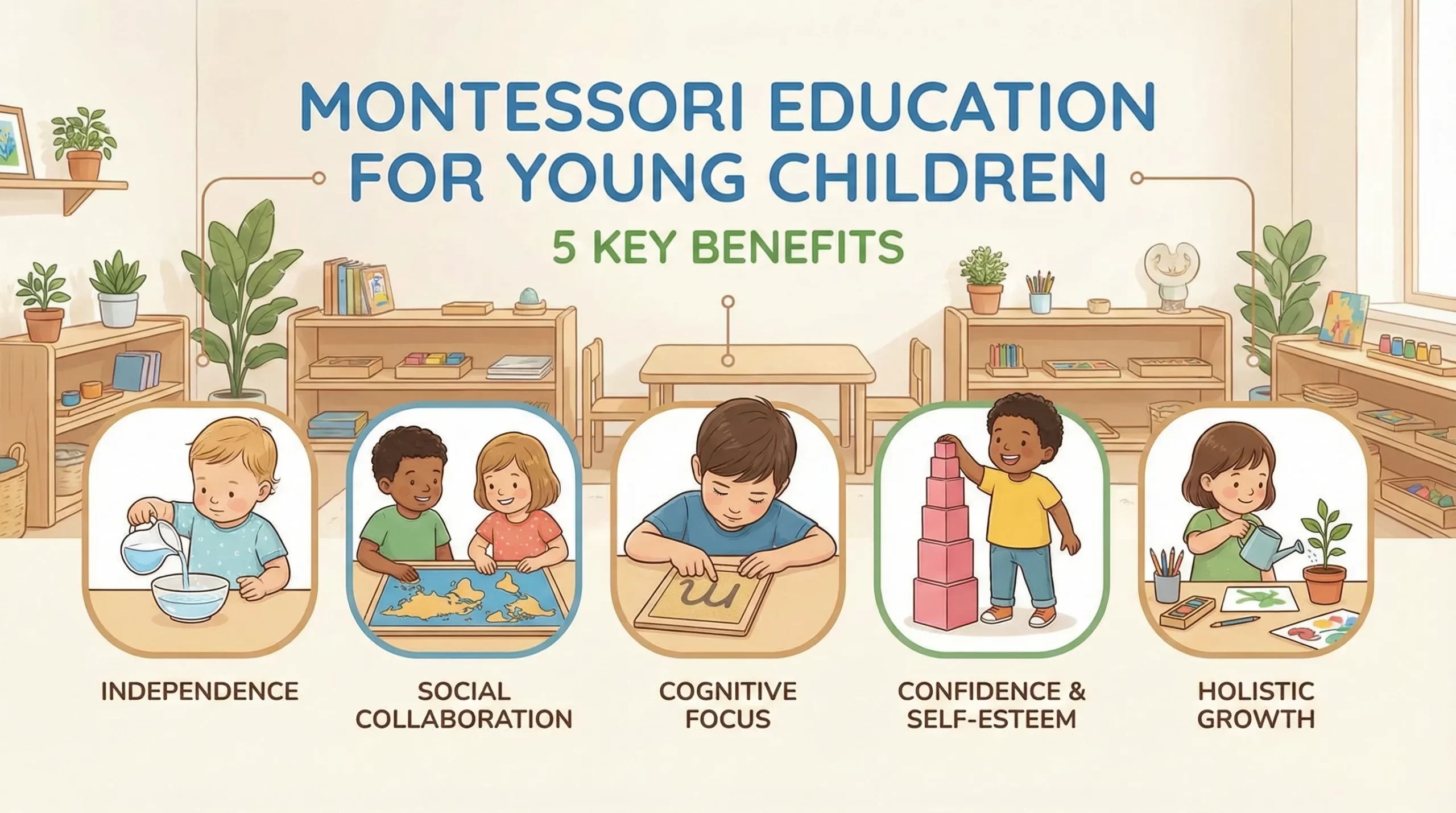
Montessori Education has become one of the most researched and widely adopted approaches in early childhood learning. Developed by Dr. Maria Montessori in 1907, this method focuses on independence, hands-on learning, and respect for a child’s natural psychological development. As of 2026, Montessori programs operate in more than 140 countries, serving children from birth to age 18.
In the United States alone, over 5,000 Montessori schools are active, according to the American Montessori Society. Parents today want evidence-based education models that support cognitive, emotional, and social growth. Montessori Education meets this need by blending structure with freedom in a carefully prepared environment. Research published by the National Center for Montessori in the Public Sector confirms that Montessori students often outperform peers in literacy, math, and executive functioning by age 5.
This article explains how Montessori Education works, why it benefits young children, and what data tells us about its real-world impact. We focus on five key benefits supported by studies, classroom outcomes, and global adoption trends.
Understanding Montessori Education
Child-Centered Learning Philosophy
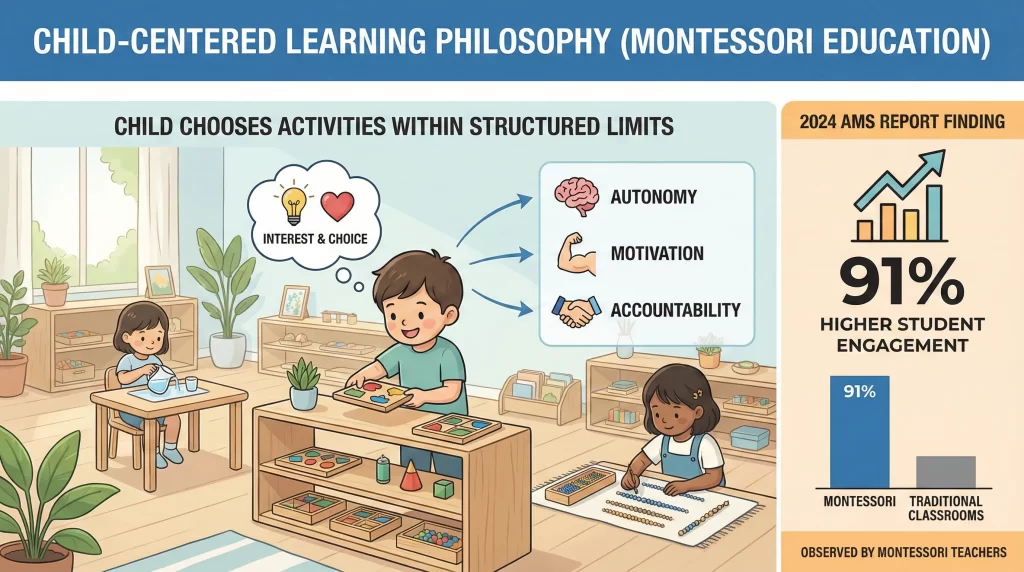
Montessori Education places the child at the center of the learning process. Children choose activities based on interest, within structured limits. This autonomy builds motivation and accountability early. According to a 2024 AMS report, 91% of Montessori teachers observed higher student engagement compared to traditional classrooms.
The approach respects developmental stages rather than age-based benchmarks. Mixed-age classrooms allow younger children to observe advanced skills while older children reinforce knowledge through mentoring. This structure consistently supports social development and peer learning. Preschool learning is one part of a child’s early growth. For a complete overview, explore our full Early Childhood Education Guide, which covers learning methods, activities, and long-term benefits.
Benefit 1: Stronger Cognitive Development
Hands-On Materials Improve Brain Function
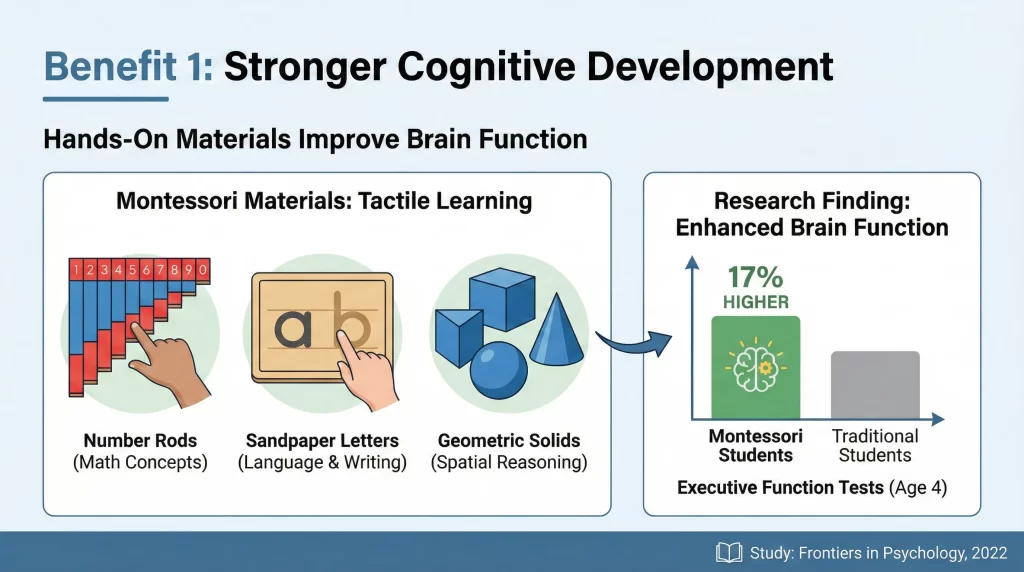
Montessori classrooms use tactile materials designed to isolate learning concepts. Examples include number rods, sandpaper letters, and geometric solids. A 2022 study in Frontiers in Psychology found Montessori students scored 17% higher in executive function tests by age 4.
Hands-on learning strengthens neural pathways linked to memory and reasoning. Children manipulate objects rather than memorize abstract ideas. This method supports deeper understanding and long-term retention across subjects. Learn how preschool education benefits help children build early social and academic skills.
Benefit 2: Improved Academic Outcomes
Literacy and Math Performance
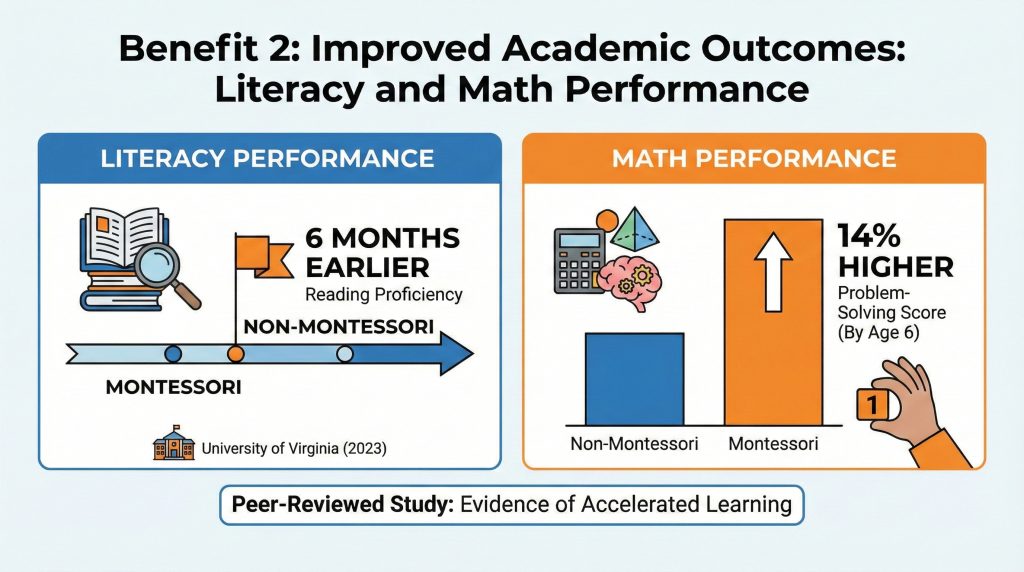
A 2023 peer-reviewed study by the University of Virginia found that Montessori students reached reading proficiency 6 months earlier than their non-Montessori peers. Math outcomes were similarly strong, with Montessori children scoring 14% higher in problem-solving tasks by age 6.
The curriculum progresses from concrete to abstract concepts. Children master fundamentals before advancing, preventing learning gaps. Teachers act as guides, observing progress rather than directing every task.
Benefit 3: Enhanced Social and Emotional Skills
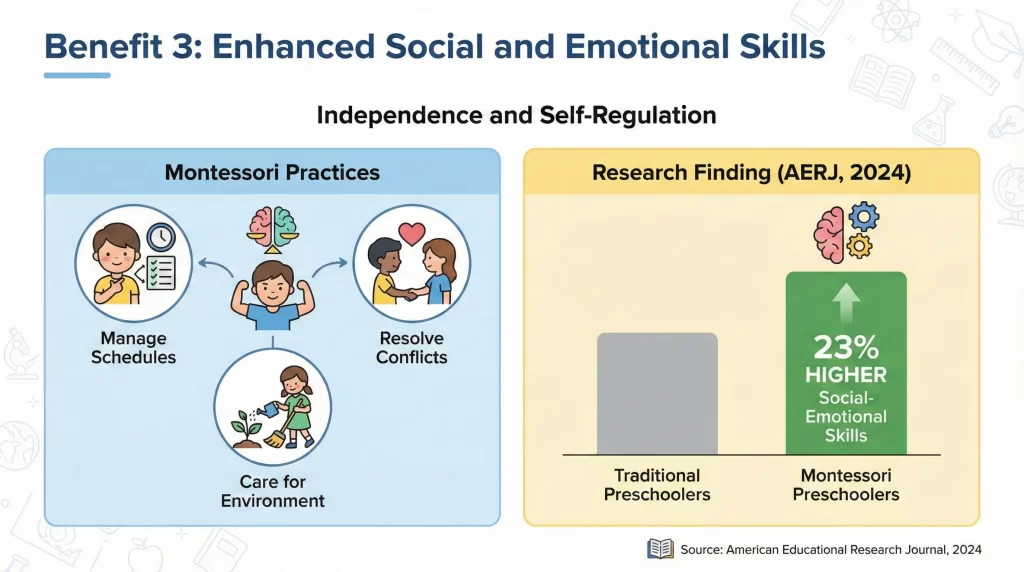
Independence and Self-Regulation
Montessori Education emphasizes self-discipline and emotional awareness. Children manage their schedules, resolve conflicts, and care for their environment. A 2024 study in the American Educational Research Journal reported that Montessori preschoolers had 23% higher social-emotional skills.
Grace and courtesy lessons explicitly teach empathy, respect, and communication. These lessons translate into fewer behavioral disruptions and stronger peer relationships over time. Discover why learning through play is one of the most effective teaching methods.
Benefit 4: Increased Focus and Attention Span
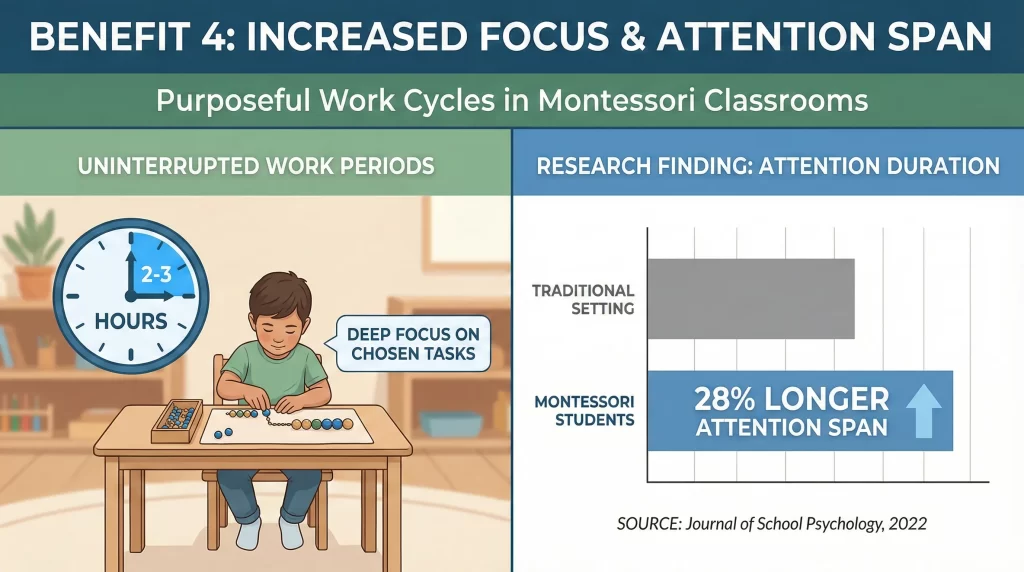
Purposeful Work Cycles
Montessori classrooms feature uninterrupted work periods lasting 2 to 3 hours. Children focus deeply on chosen tasks without constant transitions. Research published in the Journal of School Psychology in 2022 found that Montessori students maintained attention 28% longer than peers in traditional settings.
This structure naturally reduces overstimulation and improves concentration. Children learn to complete tasks fully, building persistence and confidence without external rewards.
Benefit 5: Lifelong Love of Learning
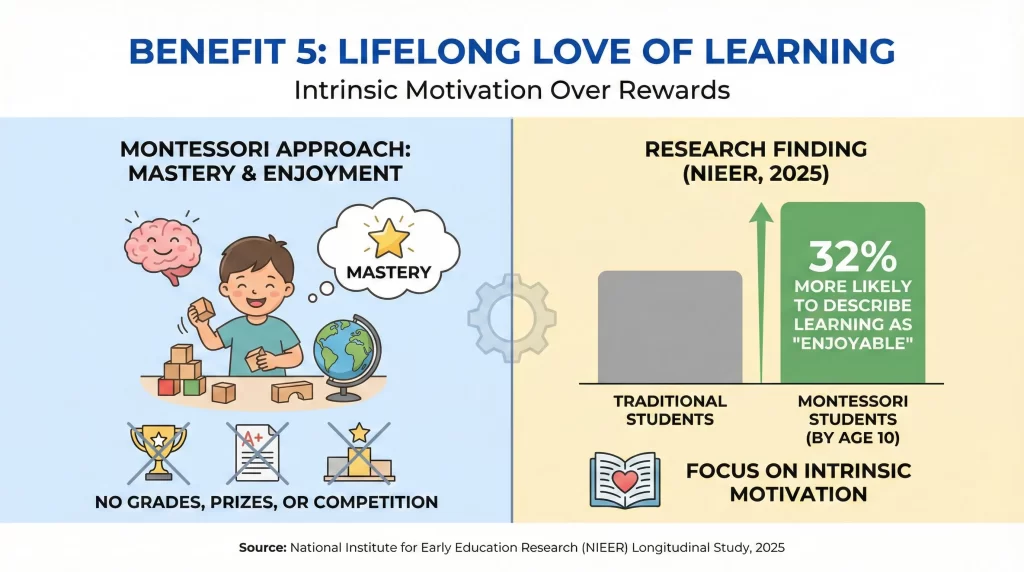
Intrinsic Motivation Over Rewards
Montessori Education avoids grades, prizes, and competition in the early years. Children learn for mastery, not approval. According to a 2025 longitudinal study by the National Institute for Early Education Research, Montessori students were 32% more likely to describe learning as “enjoyable” by age 10.
This intrinsic motivation leads to curiosity, creativity, and resilience. Children become self-directed learners who adapt well to new challenges later in life.
Key Features at a Glance
Core Characteristics of Montessori Education
- Mixed-age classrooms spanning three years.
- Certified Montessori teachers with specialized training.
- Hands-on, self-correcting learning materials.
- Uninterrupted work periods daily.
- Emphasis on independence and respect.
Montessori vs Traditional Early Education
| Feature | Montessori Education | Traditional Preschool |
|---|---|---|
| Classroom Structure | Mixed-age groups | Same-age groups |
| Teaching Style | Child-led learning | Teacher-led instruction |
| Assessment | Observation-based | Grades and tests |
| Learning Materials | Hands-on, tactile | Worksheets and books |
| Motivation | Intrinsic | Rewards and praise |
Bottom Line
Montessori Education offers a proven, research-backed approach to early childhood development. It supports academic achievement, emotional growth, focus, and independence using a child-centered framework. With over a century of application and consistent global adoption, the model continues to demonstrate measurable benefits for young learners.
Parents seeking an education system that respects individuality while delivering strong outcomes should consider Montessori Education seriously. When implemented correctly, it prepares children not just for school, but for life.
FAQs
At what age is Montessori Education best for?
Montessori Education is most effective from ages 2.5 to 6.
Is Montessori Education research-based?
Yes, multiple peer-reviewed studies support its academic and social benefits.
Do Montessori schools follow state standards?
Most align curriculum outcomes with state and national standards.
Are Montessori teachers certified?
Certified teachers complete specialized Montessori training programs.
Does Montessori Education prepare children for traditional schools?
Yes, studies show strong adaptability and academic readiness.
Disclaimer
This article is for informational purposes only and does not replace professional educational or developmental guidance.